Cloud Computing for US Growth Companies: 2026 Scalability Guide

Leveraging Cloud Computing for Operational Scalability: A 2026 Guide for US Growth Companies
In the rapidly evolving landscape of the 21st century, US growth companies face a unique set of challenges and opportunities. The imperative to innovate, expand, and maintain a competitive edge is more pronounced than ever. At the heart of this challenge lies operational scalability — the ability to efficiently manage increasing workloads, data volumes, and user demands without compromising performance or incurring excessive costs. For discerning leaders looking ahead to 2026, the answer to this critical need increasingly points towards the strategic adoption of cloud computing scalability.
Cloud computing is no longer a nascent technology; it’s a mature, indispensable backbone for modern businesses. Its inherent flexibility, cost-effectiveness, and robust infrastructure offer a powerful solution for companies aiming to scale operations seamlessly. This guide delves into how US growth companies can effectively harness cloud computing to achieve unprecedented operational scalability by 2026, exploring key strategies, benefits, and future considerations.
The Unyielding Demand for Operational Scalability
For US growth companies, the journey from startup to market leader is paved with unpredictable growth spurts, seasonal fluctuations, and the constant pressure to adapt to new market demands. Traditional IT infrastructures, with their fixed capacities and high upfront investments, often struggle to keep pace. Procuring, configuring, and maintaining physical servers, storage, and networking equipment is a time-consuming and capital-intensive endeavor. When demand surges, these systems can become bottlenecks, leading to performance degradation, customer dissatisfaction, and lost revenue opportunities. Conversely, during periods of lower demand, significant IT resources lie idle, representing wasted investment.
This is where the concept of operational scalability becomes paramount. It’s not just about handling more — it’s about handling more efficiently, cost-effectively, and on-demand. True operational scalability allows a company to expand its operations, services, and user base without fundamental changes to its core architecture or disproportionate increases in cost. It means being agile enough to seize new market opportunities, resilient enough to withstand unexpected spikes, and lean enough to optimize resource utilization. For US growth companies, achieving this level of agility is a non-negotiable requirement for sustainable success in 2026 and beyond.
Cloud Computing: The Engine of Modern Scalability
The paradigm shift offered by cloud computing fundamentally redefines how businesses acquire, utilize, and manage their IT resources. Instead of owning and maintaining physical infrastructure, companies can access computing services — servers, storage, databases, networking, software, analytics, and intelligence — over the internet from a cloud provider. This "as-a-service" model provides a suite of advantages that directly address the scalability needs of US growth companies.
Elasticity and On-Demand Resources
One of the most compelling features of cloud computing is its inherent elasticity. Unlike on-premise solutions, cloud resources can be provisioned and de-provisioned almost instantly. Need more computational power for a new product launch? Cloud platforms allow you to scale up resources in minutes. Experiencing a dip in traffic? You can scale down to reduce costs. This on-demand nature means you only pay for what you use, transforming capital expenditures (CapEx) into operational expenditures (OpEx) and freeing up valuable capital for core business investments.
Global Reach and Market Expansion
For US growth companies with ambitions beyond national borders, cloud computing offers unparalleled global reach. Cloud providers operate vast networks of data centers across the globe. By deploying applications and data closer to international customers, businesses can significantly reduce latency, improve user experience, and comply with regional data residency regulations. This global infrastructure facilitates rapid market expansion without the need for establishing physical IT presence in new territories, a significant cost and logistical barrier for many growing enterprises.
Enhanced Agility and Innovation
Cloud platforms provide a rich ecosystem of services, including advanced analytics, machine learning, artificial intelligence, and serverless computing. This allows US growth companies to experiment with new technologies and develop innovative solutions much faster than they could with traditional IT. The ability to quickly prototype, test, and deploy new applications accelerates time-to-market and fosters a culture of continuous innovation, which is vital for staying competitive.
Cost Optimization and Efficiency
While often highlighted for its flexibility, the cost optimization aspect of cloud computing scalability is equally crucial. By eliminating the need for large upfront hardware purchases, reducing maintenance costs, and enabling pay-as-you-go models, cloud services can significantly lower a company’s total cost of ownership (TCO). Furthermore, the operational efficiencies gained through automation, managed services, and reduced IT overhead allow growth companies to allocate resources more strategically towards value-generating activities.
Key Cloud Computing Strategies for 2026 US Growth Companies
Achieving optimal cloud computing scalability requires a well-thought-out strategy. It’s not simply about "moving to the cloud" but about strategically leveraging cloud capabilities to meet specific business objectives.
1. Multi-Cloud and Hybrid Cloud Approaches
As businesses mature, many find that a single cloud provider might not meet all their needs. A multi-cloud strategy involves using services from two or more public cloud providers, while a hybrid cloud combines public cloud resources with on-premise infrastructure. Both approaches offer enhanced flexibility, disaster recovery capabilities, and the ability to optimize workloads based on cost, performance, and compliance requirements. For US growth companies, this means greater resilience and avoiding vendor lock-in, crucial factors for long-term operational stability.
2. Serverless Computing and Microservices
Serverless computing (Function as a Service – FaaS) allows developers to build and run applications and services without managing servers. The cloud provider dynamically manages the allocation and provisioning of servers. Coupled with a microservices architecture, where applications are broken down into small, independent services, serverless computing enables unparalleled scalability, as each microservice can scale independently based on demand. This approach is ideal for growth companies needing to deploy new features rapidly and scale specific functionalities without impacting the entire system.
3. Data Management and Analytics in the Cloud
The ability to collect, store, process, and analyze vast amounts of data is a cornerstone of modern business intelligence. Cloud platforms offer highly scalable and cost-effective data warehousing, data lakes, and powerful analytics tools. US growth companies can leverage these capabilities to gain deeper insights into customer behavior, market trends, and operational performance, driving data-informed decisions and fostering competitive advantage.
4. Security and Compliance – A Top Priority
While cloud providers invest heavily in security, it’s a shared responsibility. US growth companies must implement robust cloud security strategies, including identity and access management (IAM), data encryption, network security, and regular security audits. Ensuring compliance with industry-specific regulations (e.g., HIPAA, PCI DSS) and data privacy laws (e.g., CCPA) is paramount, especially as operations scale. A clear understanding of the shared responsibility model is essential for maintaining a secure cloud environment.
Implementing Cloud Computing for Scalability: A Step-by-Step Approach
Embarking on a cloud journey for operational scalability requires careful planning and execution. Here’s a phased approach for US growth companies:
Phase 1: Assessment and Strategy Development
- Evaluate Current Infrastructure: Conduct a thorough audit of existing IT assets, applications, and workloads. Identify which systems are critical, which are legacy, and which are bottlenecking growth.
- Define Business Objectives: Clearly articulate what operational scalability means for your company. Is it faster customer onboarding, handling more transactions, supporting global expansion, or something else?
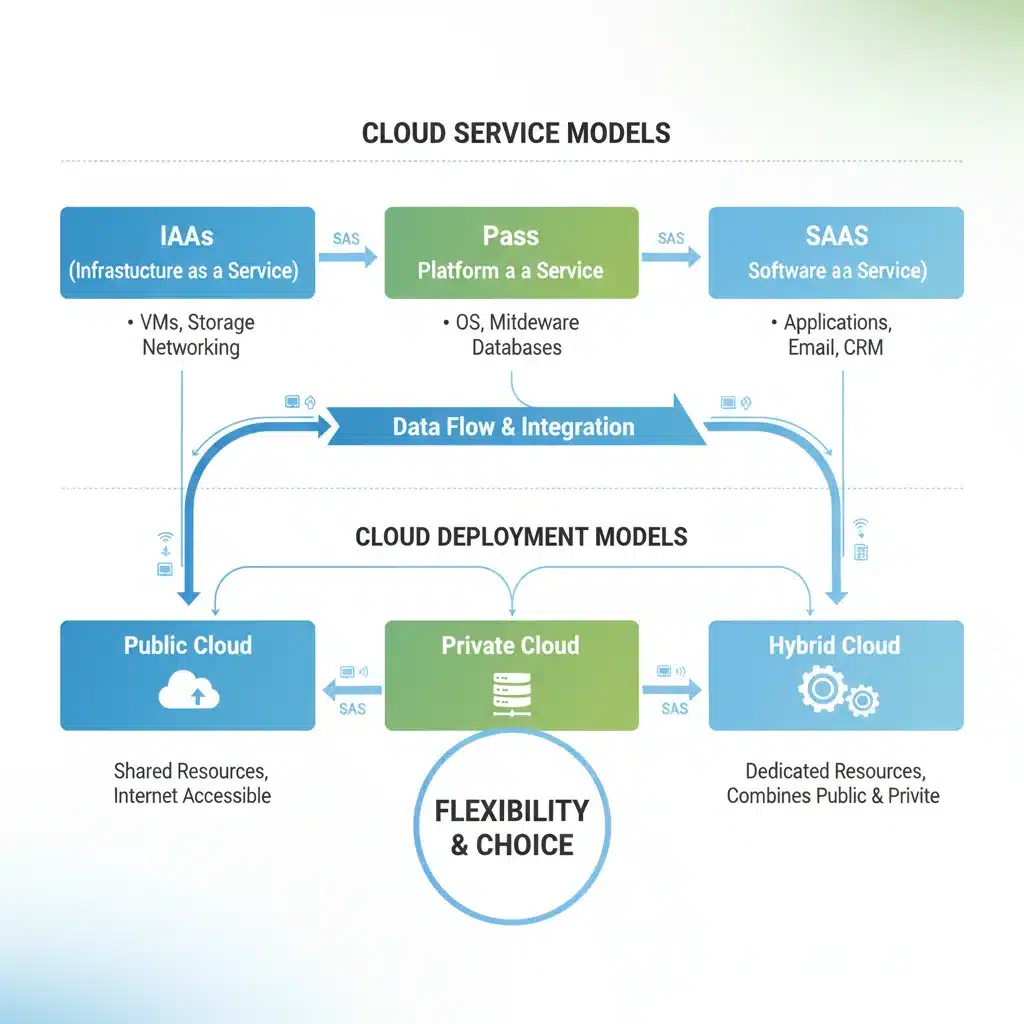
- Choose Cloud Model and Provider(s): Based on your needs, decide between public, private, or hybrid cloud. Research major providers (AWS, Azure, Google Cloud) and niche providers, considering their service offerings, pricing, compliance certifications, and geographical presence.
- Develop a Cloud Migration Strategy: Determine which applications to migrate first (e.g., "lift and shift" for simpler apps, re-platforming, or re-architecting for complex ones).
Phase 2: Pilot and Migration
- Start Small with a Pilot Project: Migrate a non-critical application or workload to the cloud to gain experience, test processes, and identify potential challenges.
- Iterative Migration: Adopt an iterative approach, migrating applications in phases, continuously monitoring performance, and optimizing configurations.
- Data Migration: Plan for secure and efficient data transfer. Consider data volume, network bandwidth, and potential downtime.
Phase 3: Optimization and Governance
- Cost Management: Implement FinOps practices to monitor and optimize cloud spending. Utilize cost management tools, reserve instances, and leverage auto-scaling to avoid over-provisioning.
- Performance Monitoring: Continuously monitor application performance, resource utilization, and user experience. Use cloud-native monitoring tools and third-party solutions.
- Security and Compliance Governance: Establish clear policies and procedures for cloud security, data governance, and regulatory compliance. Regularly review and update these policies.
- Training and Skill Development: Invest in training your IT team on cloud technologies and best practices. Cloud expertise is crucial for maximizing benefits.
Future Trends in Cloud Computing for 2026 and Beyond
The pace of innovation in cloud computing shows no signs of slowing. For US growth companies planning for 2026, understanding these emerging trends is crucial for maintaining a competitive edge and further enhancing cloud computing scalability:
Edge Computing Integration
Edge computing brings computation and data storage closer to the sources of data, reducing latency and bandwidth usage. For IoT devices, real-time analytics, and applications requiring immediate responses (e.g., autonomous vehicles, smart manufacturing), integrating edge computing with cloud infrastructure will become increasingly vital. This hybrid approach allows US growth companies to process critical data locally while leveraging the cloud for broader analytics, storage, and long-term insights.
AI and Machine Learning as a Service (AI/MLaaS)
Cloud providers are continually enhancing their AI and ML services, making sophisticated capabilities accessible to businesses of all sizes. By 2026, expect even more refined and specialized AI/MLaaS offerings, enabling US growth companies to embed intelligence into their products and operations without requiring deep in-house expertise. This will drive innovation in areas like personalized customer experiences, predictive maintenance, and automated decision-making.
Sustainable Cloud and Green IT
As environmental concerns grow, the sustainability of cloud infrastructure will become a more significant factor. Cloud providers are investing heavily in renewable energy and energy-efficient data centers. Growth companies will increasingly seek providers committed to green IT practices, aligning their operations with environmental responsibility and potentially enhancing brand reputation.
Increased Automation and Orchestration
The complexity of managing multi-cloud and hybrid cloud environments will necessitate even greater levels of automation and orchestration. Tools for infrastructure as code (IaC), automated deployment pipelines (CI/CD), and intelligent workload management will become standard, further streamlining operations and maximizing the benefits of cloud computing scalability.
Cybersecurity Mesh Architecture
With distributed cloud environments, traditional perimeter-based security models are becoming obsolete. A cybersecurity mesh architecture, which allows security controls to be deployed around individual identities or devices, will gain prominence. This approach enhances security posture across diverse cloud and edge environments, crucial for protecting valuable data as growth companies expand.

Challenges and Considerations for US Growth Companies
While the benefits of cloud computing are extensive, US growth companies must also be aware of potential challenges:
- Vendor Lock-in: Relying too heavily on a single cloud provider can make it difficult to switch later. A multi-cloud strategy can mitigate this, but adds complexity.
- Cost Management: While cloud can be cost-effective, uncontrolled spending (known as "cloud sprawl") can occur without proper governance and optimization strategies.
- Data Governance and Compliance: Navigating the complex landscape of data privacy laws and industry regulations across different jurisdictions requires meticulous planning and continuous monitoring.
- Skill Gap: Finding and retaining IT professionals with expertise in cloud architecture, security, and specific cloud platforms can be challenging.
- Legacy System Integration: Integrating older, on-premise systems with new cloud-native applications can be complex and require significant effort.
Conclusion: Cloud Computing as a Strategic Imperative
For US growth companies looking to thrive and expand by 2026, leveraging cloud computing scalability is not merely an IT decision; it’s a strategic imperative. The ability to rapidly scale resources up or down, innovate at speed, reach global markets, and optimize costs provides an undeniable competitive advantage. By carefully planning their cloud strategy, embracing modern architectures like serverless and microservices, and prioritizing security and governance, these companies can build resilient, agile, and future-proof operations.
The journey to full cloud optimization is ongoing, but with a clear vision and a commitment to continuous learning and adaptation, US growth companies are well-positioned to harness the full power of the cloud to achieve their ambitious goals. The future of operational scalability is undeniably in the cloud, and businesses that embrace this reality today will be the leaders of tomorrow.